Sears Jointer Jointer With Auto Feed
Top 10 Best planer jointer combination -Editor's Choice
We used many criteria to find the best planer jointer combination. We looked at how well they worked, how easy they were to use, and if they had any special features that might make them more desirable than others. We also looked at the materials and designs used to make them and their overall durability. We wanted to find the best planer jointer combination on the market, so we considered these things carefully. We selected our best recommendations based on the following criteria:
- Quality
- Price
- Types
- Materials
- Ease of Use
- Function
- Durability
- Longevity
- Warranty
Popularity Score 9.2
Quality Score 9.4
Sentiment Score 9.5
Editorial Score
 9.4
9.4
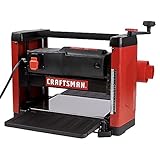
Highlighted Features
- CLEANER WORKSPACE: Vacuum port for dust collection
- LONG CUTTING LIFE: High carbon steel, double edged, reversible knives for long cutting life
- SMOOTH OPERATION: The wood planer featuring two knife, quick change, solid steel cutter head mounted on ball bearings, assures smooth operation and long life
- MAXIMUM STOCK REMOVAL: The thickness planer features Poly-V Cutterhead drive for maximum stock removal
- HARD AND SOFT WOOD MATERIAL REMOVAL: 15 Amp motor of the woodworking planer provides power for both hard and soft wood material removal
Popularity Score 8.9
Quality Score 9
Sentiment Score 9
Editorial Score
9.0
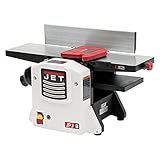
Highlighted Features
- POWERFUL: Heavy-duty 13-amp motor for various cutting applications.
- PORTABLE: Integrated cord wrap makes transporting easy and ensures workshop safety.
- PRECISION: Large aluminum-extruded fence makes joining stable and precise.
- COMPACT: Combination benchtop jointer and planer provides a 2-in-1 machine to maximize work space.
- COMFORTABLE: Oversized, ergonomic knobs provide ease of use and maximum control.
Popularity Score 9.7
Quality Score 9
Sentiment Score 8.9

Editorial Score
9.2
Highlighted Features
- STRENGTH AND DURABILITY: Heavy-duty cast iron and steel construction.
- ACCURACY: Large handwheel for quick and precise adjustments of planer table.
- SUPERIOR FINISH AND QUIETER CUT: Helical cutterhead with 56 indexable carbide inserts.
- STABILITY: Heavy-duty, one-piece steel closed stand includes mounting tabs.
- CONSISTENT POWER: Powerful 3-HP induction motor.
Popularity Score 9.6
Quality Score 9.8
Sentiment Score 9.3

Editorial Score
9.6
Highlighted Features
- Ideal Uses: Small shop environments (not commercial grade) and limited space.
- Added Safety: Telescoping blade guard.
- Precision Cutting: Planing and joining tables are adjustable with a removable handle and locking knobs.
- Compact Design: Combination benchtop jointer and planer provides a 2-in-1 machine with a space-saving footprint.
- Simple Mobility: With an integrated cord wrap, and weighing just 74 lbs. (with stand), this compact machine is easy to relocate.
Popularity Score 9.2
Quality Score 9.4
Sentiment Score 9.6

Editorial Score
9.4
Highlighted Features
- Remove 0 to 1/8 of an inch of material with each pass
- Features a spacious 30-by-6-inch table
- Adjustable 19-3/4 by 4-1/4-inch fence bevels up to 45 degrees
- Spiral cutterhead system utilizes 12 staggered HSS blades for an ultra fine finish
Popularity Score 9.2
Quality Score 9.8
Sentiment Score 9.1
Editorial Score
9.4
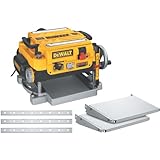
Highlighted Features
- Fan-assisted chip ejection vacuums chip off of the cutter head and exhausts them out of the machine
- Two-speed gear box of the wood planer allows users to change feed speed to optimizing cuts per inch at 96 or 179 CPI
- 19-3/4-inch cast aluminum base is 2 times more rigid than a standard 10-inch base and folding tables
- Extra large turret depth-stop allows users to return to most frequently used thicknesses with ease
- Three knife cutter head of the thickness planer delivers 30% longer knife life and makes knife change faster and easier
Popularity Score 8.9
Quality Score 9.7
Sentiment Score 9.8
Editorial Score
9.5
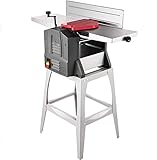
Highlighted Features
- 【CONSIDERATE DESIGN】- The dust exhaust interface can connect to dust collectors for easy cleanup of the flying wood chips to cultivate a clean working environment; This compact design of the jointer planer maximizes space-saving use.
- 【RELIABILITY & SAFETY】- Equipped with power-off protection electromagnetic switch, the over current protector, can be tripped when the motor is overloaded.
- 【TWO-IN-ONE DESIGN】- Combine a benchtop jointer and a planer in one unit, a two-in-one benchtop jointer can maximize workspace. A crank handle for easy adjustment of the height of cutter head; scale ruler for precise machining, automatic feeding design is available when it becomes a planer.
- 【PREMIUM QUALITY】- High-quality jointers woodworking equips the full metal workbench. With a maximum cutting width of 8 inches (20.32 cm), No-load speed:9000RPM/min, Power: 1500W, Feeding speed of 6M/min.
- 【WIDE APPLICATION】- Benchtop planer is designed for planing of old, weathered, rough and worn wood, and giving it an exceptionally smooth finish. Planers woodworking can be used for planning wood, bamboo, lining nylon, etc.
Popularity Score 9.1
Quality Score 9.2
Sentiment Score 9.8

Editorial Score
9.4
Highlighted Features
- Made of M2 High Speed Steel for longer cutting life
- 6-1/8- Inch jointer Planer Blades Fits Craftsman 21705, 922995, 113.20680, 113.232210, 113-206932 & 113-206891, 1113.206801 ,113-206931, 113-232200.
- Set of 3, Plastic case packaging
- Blade dimension: 6-1/8-Inch x 11/16-Inch x 1/8-Inch
Popularity Score 9.6
Quality Score 9.2
Sentiment Score 9.8
Editorial Score
9.5
Highlighted Features
- ACCURACY: Heavy-duty cast iron tables with a machined finish ensures accuracy and flatness.
- ADAPTABLE: Extrmemly quick changeover between jointing and planing functions. Fence does not need to be removed.
- RAPID CUTS: Three, high-speed, steel knife cutter head provides rapid cutting and a superior finish.
- EFFICIENCY: Built-in dust chute with 4" dust port is used for both jointing and planing operations.
- STABILITY: Heavy-duty, one-piece steel closed stand (includes mounting tabs).
Popularity Score 9.5
Quality Score 8.9
Sentiment Score 9
Editorial Score
9.1
Highlighted Features
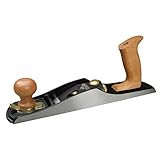
- Ductile iron castings for weight and durability
- Patented lateral adjustment locking feature
- One-piece base and frog virtually eliminate chatter and increased accuracy
What To Consider When Choosing The planer jointer combination
As a result of combining a jointer and a planer into a single piece of machinery, many technical specifications and several practical aspects need to be considered. This is not something that will come as a surprise to anyone. We have broken these down into manageable sections that, when put together, will provide a comprehensive overview of the capabilities of virtually any jointer planer combo.
Size and Weight
Compared to having two separate machines, a jointer and planer combo can save you a significant amount of space, which is one of its primary advantages. Nevertheless, this does not imply that they are necessarily diminutive in size. Jointer beds can be up to four feet long; while the tool itself is quite portable at 58 pounds, larger models can weigh more than 500 pounds. Jointer beds are also available in a variety of widths.
It is not necessary to check the physical dimensions of a portable planer before purchasing one, but doing so before purchasing a jointer planer is essential in order to plan where the machine will be installed. Also, remember that the tool might need some assembly before it can be used. It's not too difficult to put together most things, but some of the parts can be quite heavy, so it's smart to have some assistance on hand.
Both Power and Rapidity
Amps are frequently used to measure the performance of power tools, but horsepower is the standard unit of measurement for jointer-planer combos (hp). Very few are under 1 horsepower, while large machines can reach up to 5 horsepower in some cases.
Despite this, it is essential to check the amp rating and voltage because both factors affect the installation process. The maximum current drawn from a standard household outlet is 15 amps, and the voltage is 110 volts (V). Because some of these combination tools require more power at 220/230V, you will either need a separate supply or an upgraded one.
There are two different ways to measure the speed of a jointer or planer:
The amount of feed delivered is expressed in feet per minute (fpm). This is the maximum possible speed at which the planer can move the wood. Productivity increases in direct proportion to the speed of travel.
The speed of the cutter head, also known as the cutter block, is measured in revolutions per minute (rpm). The smoother the finish that is produced by a cutter head, the faster its rotational speed. On the other hand, one must consider the total number of blades, also sometimes called knives.
Different Types of Blades and Cutterheads
The cutterhead of a conventional jointer planer typically houses two or three lengthy knives, typically crafted from high-speed steel (HSS). The actual number of cuts made per minute can be calculated by multiplying the speed of the cutterhead by the number of knives. For instance, a two-knife cutterhead that rotates at 9,000 revolutions per minute produces 18,000 cuts per minute. A three-knife cutterhead may rotate at a slower rate (5,500 rpm), but it produces nearly the same number of cuts per minute (in this case, 16,500) and likely operates at a lower decibel level.
The helical (or spiral) cutter head, which can have as many as 56 small square blades and is organized in rows that curve around the head, is an innovation that has been incorporated into this design. These are typically made of tungsten carbide, which maintains its sharpness for longer than HSS. The helical pattern features cutting edges that are almost continuously present, which enables an excellent finish quality. Sanding is not always necessary because the surface is sometimes already smooth enough.
When the square blades become dull, they can easily be loosened and rotated to a new position, where they will have a fresh edge. However, at some point in the future, each one of them will have to be replaced, which is a process that takes a lot of time. The cost of the machines is also significantly higher when they have helical cutterheads.
The bed's width as well as the cutting depth
The bed width of a jointer/planer combo is typically used as the defining characteristic, as this indicates the maximum size board that can be jointed or planed by the machine. It is also a good idea to check the bed length, as most machines are either 8 inches, 10 inches, or 12 inches wide.
Sniping is when the cutter takes a deep chunk out of the board at the start or finish of the cut. Sniping can be prevented by using a longer bed because it provides the board with more support and helps prevent sniping. Having said that, it does affect the necessary amount of physical space.
Although it is possible for there to be some variation between the two functions, the maximum depth of cut on most jointer planer combos is 1/8 of an inch. The final cut, on the other hand, will typically be made to be shallower to create a smoother finish.
Material for Construction
A key characteristic of jointer-planer combos is the material that is utilized for the tables and the fence. Both of these components are typically made of extruded aluminium on entry-level machines. This results in a weight reduction and helps keep costs down.
Reinforcing webs are added because there is a possibility that they will flex or twist, which would compromise their accuracy. On certain models, the use of sheet metal is also a possibility. Although it is more affordable and long-lasting than aluminium, this material might eventually develop rust spots.
In most cases, the tables on the best jointer planer combos are made of cast iron, while the fences are made of aluminum. It has a very high level of rigidity and can dampen machine vibration, both of which contribute to an improvement in precision; however, it is a weighty material.
Stands are typically made of steel, although some parts of the casing of budget models may be made of plastic. This does not provide an especially high level of durability in busy workshop environments; however, damage to this is typically cosmetic and should not affect function.
Standard Format
Our top pick for the smallest jointer planer combo is a benchtop machine, making it an excellent option for woodworkers working in smaller spaces, such as at home or in shops with restricted floor space. The vast majority, on the other hand, hold some kind of position.
A stand that resembles a small table and is constructed out of a straightforward, open steel frame may be included with relatively lightweight models. Because they can become loose with continued use, it is a good idea to give them an occasional go around with a wrench.
When it comes to more substantial machines, the stand might be an entirely enclosed cabinet. These offer the necessary support for cast-iron tables and prevent sawdust from entering the mechanism of the planer. Typically, they do not provide storage space.
Cleaning Up the Dust
Combination jointer/planer machines generate a significant amount of waste. Wood chips and sawdust have the potential to become everywhere if there is not some form of dust collection. The inhalation of airborne dust not only threatens one's health but also can ruin varnished finishes and is a nuisance when cleaning the workshop.
Every jointer and planer on the market comes equipped with an outlet port that allows the user to connect a shop vac or a more powerful dust extractor. Because diameters can change, it's important to double-check all of the models that are up for debate. Additionally, low-cost adapters are readily available in a variety of places.
Source: https://www.goultralow.com/best-planer-jointer-combination/
0 Response to "Sears Jointer Jointer With Auto Feed"
Post a Comment